
Replacing an entire automatic transfer switch (ATS) isn’t your only option when legacy controls fail or components become obsolete. Discover how a control panel conversion modernizes your emergency power infrastructure, slashes downtime, and maximizes your capital budget—without requiring a full enclosure tear-out.
For commercial, industrial, and institutional facilities, emergency power isn’t a luxury—it’s an operational necessity. When an emergency backup system ages, the automatic transfer switch (ATS) is often the most critical point of vulnerability.
As manufacturers phase out legacy equipment, sourcing obsolete proprietary relays or original mechanical components becomes expensive and introduces unacceptable delays into your contingency planning.
Faced with an aging ATS, many facility managers assume their only choice is a complete, capital-heavy system replacement. However, at GenWorx Power Systems, we frequently recommend a smarter, more efficient alternative: an ATS control panel conversion.
An ATS consists of two main elements: the heavy-duty mechanical switching mechanisms (enclosure, power busses, contactors) and the electronic “brain” that monitors power utility lines and commands the generator to start.
In a control panel conversion, the robust structural infrastructure is retained, while the obsolete, unreliable analog or early-generation digital controls are retrofitted with a modern, high-precision microprocessor control board.
As shown in the recent field conversion below, our technicians removed an obsolete legacy controller and seamlessly integrated a modern digital control board into the original enclosure—all without disturbing the core structural buswork or requiring invasive structural work:
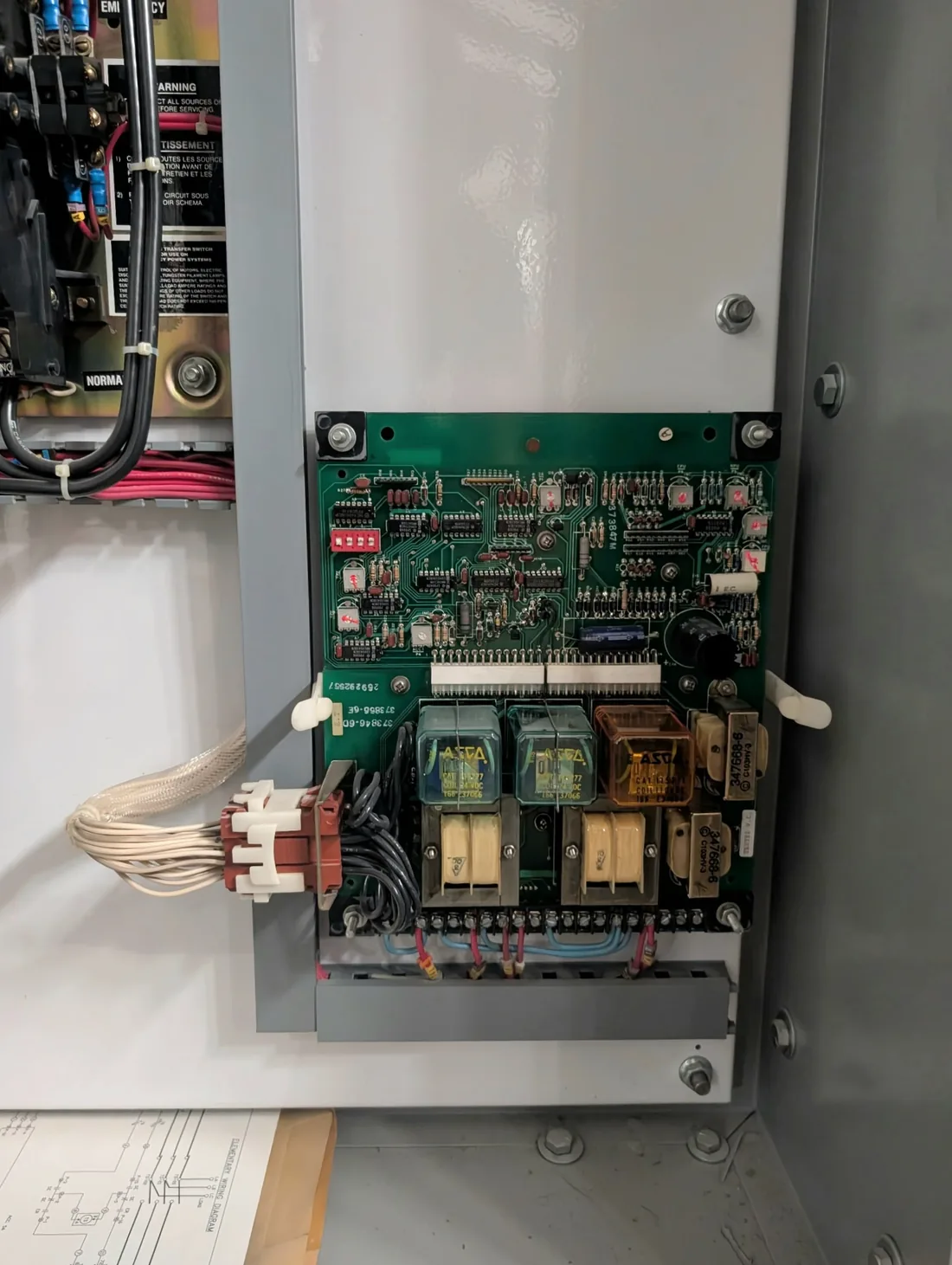
Before: Aging analog ATS control board prior to retrofit, featuring legacy relay architecture and no active diagnostic interface.
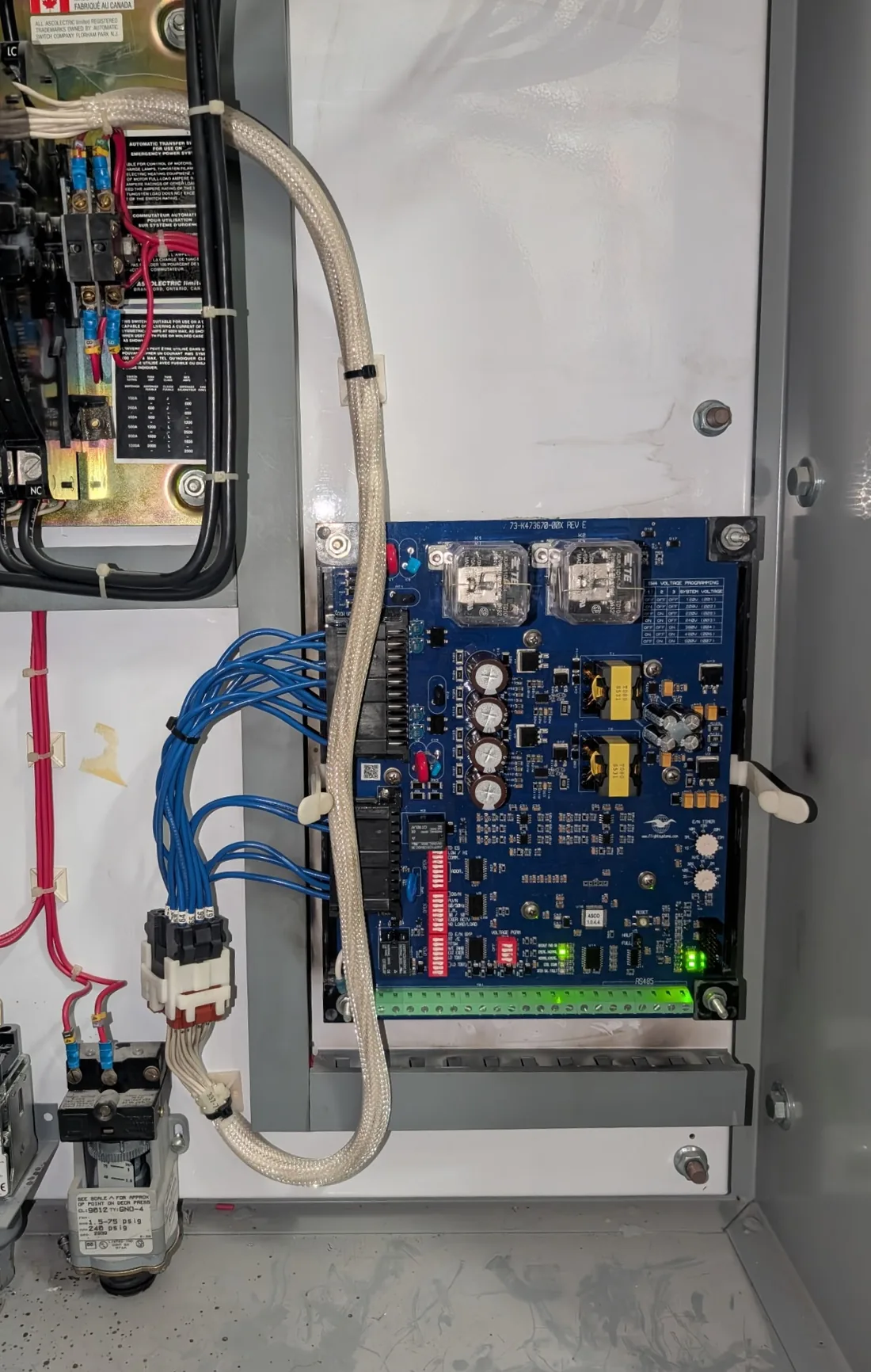
After: Modern microprocessor control unit retrofitted into the existing enclosure—restoring peak reliability and adding instant visual diagnostics.
The newly integrated digital control board provides hyper-accurate, real-time voltage and frequency sensing across all phases, allowing for precise event logging and smarter power transitions.
Obsolete wiring harnesses are replaced with custom-bundled configurations, protected by heavy-duty, heat-resistant braided sleeving to prevent long-term wear, friction, and environmental degradation.
Modern LED status indicators and integrated interfaces allow facility engineers to verify power flow configurations and system health at a single glance.
Tearing out an entire multi-amperage ATS enclosure requires massive structural labor, complex conduit reconfiguration, and significant expenditure on raw materials. A control panel conversion targets only the component that has become obsolete—the electronics—allowing you to allocate your capital budget where it is truly needed.
A full equipment replacement can leave a facility vulnerable or reliant on temporary power solutions for days. Because a controller retrofit works within the existing structural framework, our technicians can complete the transition swiftly, minimizing disruption to your facility’s daily operations.
Older control systems lack the detailed logging and advanced diagnostics required for proactive modern facility management. By upgrading to a supported digital platform, you gain reliable fault tracing, predictable performance, and the assurance that future replacement parts and technical support will be readily accessible.
An emergency standby generator is only as reliable as the switch that commands it to run. If your commercial property or industrial facility is relying on an aging, unsupported ATS interface, you don’t necessarily need to start from scratch.
Contact GenWorx Power Systems today to speak with our technical service team about an on-site evaluation and find out if a control conversion is the right fit for your facility’s asset management strategy.
Most failures give warning first. Here is what to look for.
A generator that starts is not a generator that works.
Weekly, monthly, semi-annual and annual — and who is responsible.